
ECESP Annual Conference 2026 – key takeaways
This week, Brussels became the centre of Europe’s circular economy debate. The ECESP Annual Conference 2026 brought together policymakers, industry leaders, and practitioners to discuss the future of circularity in the EU. Under the theme “A competitive and fair circular Europe: The ambition at the heart of the Single Market”, this year’s conference focused on one of the most anticipated policy developments - the upcoming Circular Economy Act (CEA).
From ambition to implementation
The first day of the conference was dedicated to high-level discussions on the political ambitions behind the CEA.
Key topics included:
the role of circular economy in strengthening the Single Market
global implications of Europe’s circular transition
mobilising finance for circularity
and the importance of intergenerational fairness, with a strong focus on youth engagement
Importantly, the ECESP Coordination Group was actively involved throughout both days of the conference - contributing to discussions, shaping the agenda, and ensuring strong stakeholder representation.
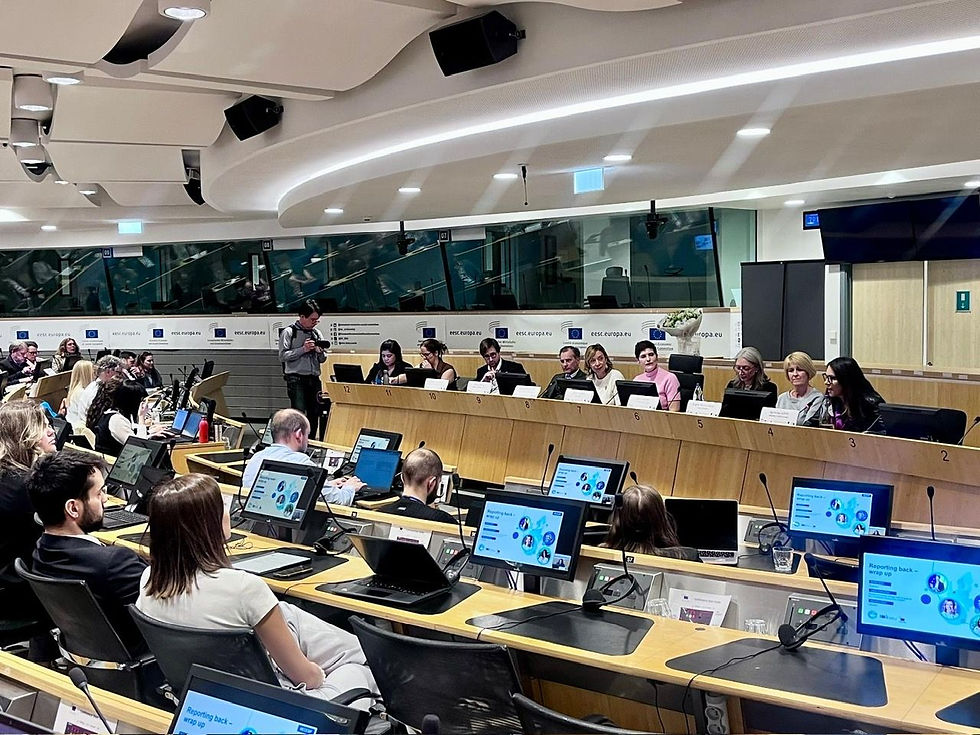
Day two, dedicated to Stakeholder Day, was particularly shaped by the Coordination Group, which co-organised and led multiple sessions. These focused on practical challenges related to implementation - from financing mechanisms and public procurement to packaging, critical raw materials, and the role of cities and regions.
A system shift: circular economy, bioeconomy and the Single Market
One message clearly emerged: Europe is entering a new phase of transformation.
Circular economy is no longer a standalone concept. It is increasingly interconnected with the bioeconomy and the functioning of the Single Market. Together, they form a system that is essential for Europe’s competitiveness, resilience, and strategic autonomy.
The ambition is clear:
put circularity at the core of the Single Market
strengthen cooperation with global partners as part of the CircularTransition
The missing piece: scale
Across sessions, one insight kept coming back: Europe does not lack innovation. It lacks scale, integration, and aligned market conditions.
While innovative solutions are being developed across Europe, many struggle to move beyond pilot phase. This so-called “second valley of death” remains a critical barrier.
Key challenges include:
high costs and regulatory complexity
fragmented value chains
limited market uptake
Bioeconomy: from niche to system
The bioeconomy is rapidly gaining importance in this transition.
No longer limited to alternative materials, it represents a systemic shift - from a fossil-based economy to one built on renewable, circular biological resources.
However, scaling bio-based solutions requires:
better integration across sectors
stronger policy alignment
and improved market conditions
INNOWO and ECESP Coordination Group in action
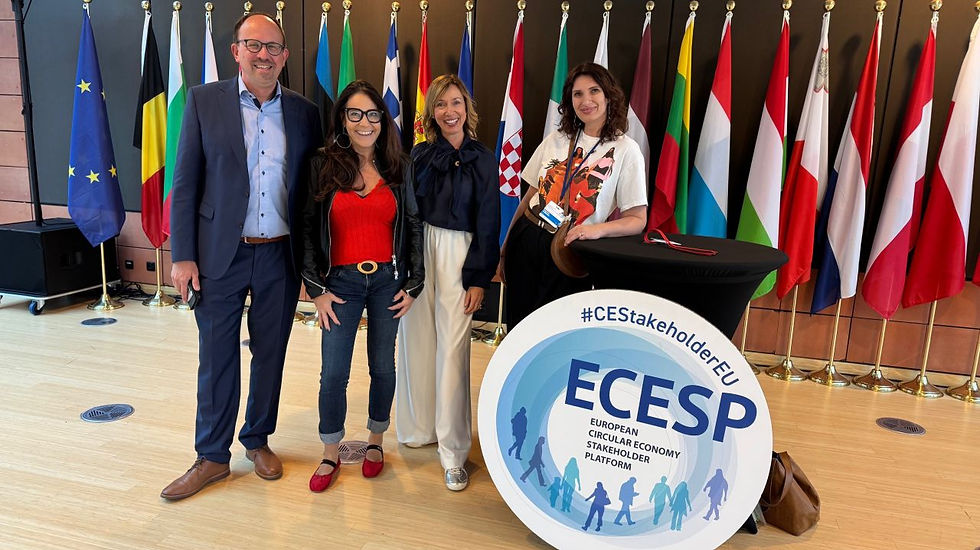
During the conference, Agnieszka Sznyk, acting as ECESP Co-Chair, actively contributed to the programme - including moderating a session on the bioeconomy, a topic increasingly central to Europe’s competitiveness and resilience.
At the same time, INNOWO, as coordinator of Leadership Group #2 “Advancing an integrated circular bioeconomy”, played an active role in showcasing the group’s work and ambitions.
Members of the group presented their priorities and goals for the coming years during both a dedicated workshop and at the booth - highlighting the need for stronger integration of circular economy and bioeconomy across policies, value chains, and markets.
INNOWO at the heart of the discussion
From innovation to implementation: NYMPHE project
At the event, INNOWO also presented the NYMPHE project, which focuses on tackling environmental pollution through innovative bioremediation solutions.
A new Technology Booklet was showcased, presenting 10 emerging solutions:
4 wastewater treatment technologies
3 soil remediation technologies
3 microbiome modelling approaches
These innovations demonstrate how bioeconomy can deliver concrete, scalable solutions to environmental challenges.
More about project: https://www.nympheproject.eu/
From Single Market to “One Market”
A strong political message echoed throughout the conference: Europe’s challenge is not over-integration - it is insufficient integration in key sectors.
Energy, finance, and connectivity remain fragmented, limiting the ability to scale circular and bio-based solutions. Without a true “One Market”, there is no scalable circular economy.
What comes next?
The upcoming Circular Economy Act will be a crucial step in shaping the future of Europe’s economy. However, regulation alone will not be enough.
To unlock the full potential of circularity, Europe needs:
stronger market integration
better conditions for scaling innovation
and closer cooperation between policy, business, and society
The direction is clear - now the focus must shift to implementation.


Comments